


Marketplace Payments: From Checkout to Seller Payout
A payment solution for marketplaces: accept payments from buyers, split them between your platform and sellers, hold funds in escrow and pay sellers out. One onboarding, one contract and one account manager for B2B, multi-vendor, service and rental marketplaces.
Split paymentsEscrowSeller payoutsFrom 5 days to connect
Talk to our team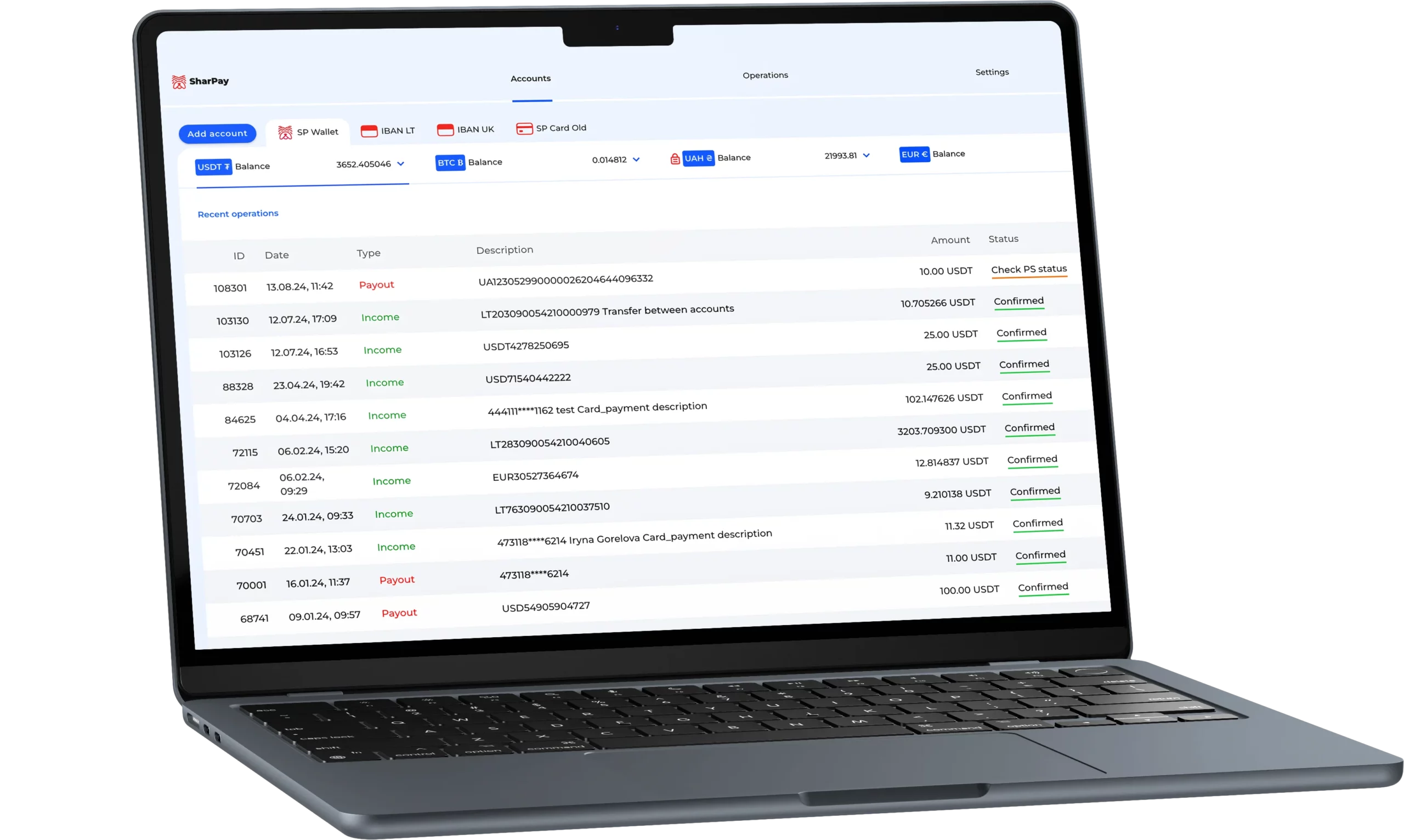
Why SharPay for Marketplace Payments
Key Features
✅ Payment Processing
Cards, local methods and crypto at one checkout.
Cascade across two providers.
✅ Split Payments
Your fee and the seller’s share in every payment.
Split rules set for your model.
✅ Escrow
Funds held after the buyer pays.
Released when the order is confirmed.
✅ Seller Payouts
EUR, USD, GBP and crypto.
In bulk or one by one, on your schedule.
✅ Seller Onboarding
Checks built into onboarding.
Suspicious sellers stopped before payout.
✅ Business IBAN Account
Receive B2B bank transfers.
Pay sellers from the same balance.
How Marketplace Payment Processing Works
Every marketplace order follows the same route. SharPay covers each step as one payment gateway for marketplaces, so you see one flow instead of four systems.
1. The buyer pays
By card, local payment method or crypto at your checkout. If one provider declines, the payment goes through the second one in the cascade.
2. The payment is split
Your commission stays with the platform, while the seller’s share is recorded for payout. No manual reconciliation at month end.
3. Funds wait in escrow
For services, rentals and high-value goods, the money is held until the order is confirmed. If something goes wrong, the dispute is settled before any money has left.
4. The seller gets paid
To a bank account, card or crypto wallet, in bulk or one by one, on the schedule you set.
Payments for B2B, Multi-Vendor and Online Marketplaces
Online marketplace payments work the same way on any platform where buyers pay for something that other people sell or provide.
B2B marketplaces
Wholesale and procurement platforms where orders are large and buyers pay by bank transfer as often as by card. A business account with IBAN lets you receive those transfers and pay sellers from the same balance.
Multi-vendor online marketplaces
Platforms with hundreds of sellers, each with their own products, prices and payout details. Split and payout rules work the same at any number of sellers.
Service and rental platforms
Platforms that take money upfront and release it to the provider only after the service is delivered. Escrow is built for exactly this case.
White label marketplace payment platform
Marketplaces that want their own checkout and their own wallet for sellers can run the same infrastructure under their name with SharPay White Label.
Marketplace Split Payments and Escrow
A marketplace takes money on behalf of many sellers, keeps its fee and pays everyone else. Doing that by hand works for ten orders and breaks at a thousand.
What split payments give you
- Your fee separated at once — the commission stays with the platform in every transaction
- Seller balances in real time — each seller’s share is recorded the moment the buyer pays
- Books that match — payments, fees and payouts come from one flow, not three reports
- Rules for your model — how the split works is agreed for your marketplace during setup
How marketplace escrow works
After payment, the money does not go straight to the seller. It waits until the order is confirmed, and only then is it released for payout. Buyers get protection, sellers get certainty that the payment is real, and the platform does not have to claw money back after a dispute. More on the mechanics in split payouts and escrow that work.
Marketplace Payouts to Sellers
Sellers judge a marketplace by how fast and how predictably it pays. Late or confusing payouts are the most common reason good sellers leave.
How sellers get paid
- Currencies — EUR, USD, GBP and crypto
- Destinations — a bank account, a card or a crypto wallet
- Bulk or single — pay all sellers in one run or each one separately
- Your schedule — daily, weekly or on order confirmation — the platform decides
Why payout timing matters
A seller who knows when the money arrives plans stock and prices around your platform. A seller who waits and guesses moves to a competitor. That is why SharPay works as a marketplace payout solution where the schedule is agreed with you at setup, not imposed by the provider. Timing, frequency and holds are covered in our guide to marketplace seller payouts, and payout fees are on the price page.
Seller Onboarding and KYC for Marketplaces
Every marketplace has to know who it pays. The task is to stop the wrong sellers without making the right ones wait for weeks.
What is checked
- The marketplace itself — company registration documents, licences where they are needed and the business model
- Sellers — identity or company details and the account they are paid to
- Ongoing activity — unusual payouts and refund patterns are flagged before money leaves
Without slowing down good sellers
Seller checks are part of onboarding, so a legitimate seller gets through quickly, while a suspicious one is stopped before the first payout. How the checks are shared between your team and ours is agreed at connection. What to check and in what order is explained in checking marketplace sellers without killing your onboarding.
How to Choose a Marketplace Payment Provider
Almost any provider can accept a card. The differences show up later, once you have a thousand sellers and the first disputes. Before signing, check these four things; the longer list is in six things to require before you sign.
Split and escrow out of the box
If the provider can only accept payments, you will build the split logic yourself and carry the reconciliation for as long as the marketplace exists.
Payout currencies and methods
Your sellers live in different countries. Make sure they can be paid in their own currency without a chain of conversions eating into every payout.
A backup route for payments
One acquirer is a single point of failure. A second provider in the cascade keeps checkout running when the first one declines or goes down.
Who carries disputes
On a marketplace, chargebacks land on the platform first. Ask how refunds and disputes are handled before the first one arrives; we explain it in how marketplace payments work.
How to Start with the SharPay Marketplace Payment Solution
Connection goes through an account manager, so you don’t have to figure out the setup alone.
1. Send a request
Tell us about your marketplace: what is sold, the monthly volume and where your sellers are based.
2. Pass verification
We check the company behind the platform: registration documents, licences where they are needed and the business model.
3. Agree the setup
Together we set the split rules, escrow conditions and payout schedule. Rates are individual and depend on your business.
4. Go live
Connection takes from 5 days, depending on your documents and how complex the setup is.
FAQ
Q: How do marketplace payments work?
A: The buyer pays the platform, the platform keeps its commission, and the rest goes to the seller, either at once or after the order is confirmed. The full route is explained in how marketplace payments work.
Q: How do marketplaces split payments between sellers and the platform?
A: The split is set in the payment rules: for example, 10% stays with the platform and 90% goes to the seller’s balance. With SharPay, this happens at the moment of payment rather than at month end.
Q: What is a marketplace escrow system?
A: Escrow holds the buyer’s money after payment and releases it to the seller only when the order is confirmed. That protects the buyer and removes the risk of paying for an order that never arrived.
Q: What payout schedule do marketplace sellers expect?
A: Weekly payouts are a common standard, although active sellers often ask for faster ones. On SharPay the schedule is yours to set.
Q: What KYC checks are required when onboarding marketplace sellers?
A: As a rule, the seller’s identity or company details and the account they are paid to. The exact list depends on the country and on what is sold.
Q: How much do marketplace payments cost?
A: It depends on your vertical, volumes and the payout methods your sellers use. Terms are individual, so the quickest way to get a number is to send us a request.