


Crypto payment processor for business
SharPay handles crypto payments as a full service, not just a button on your checkout. We verify your business, accept crypto from your customers, show every payment next to your card revenue and let you pay partners in crypto. A manager agrees the terms with you, so the setup matches how your business actually earns money.
Acceptance, checks, payoutsKYC, KYB and AMLCrypto and cards in one placeOnboarding with a manager
Talk to sales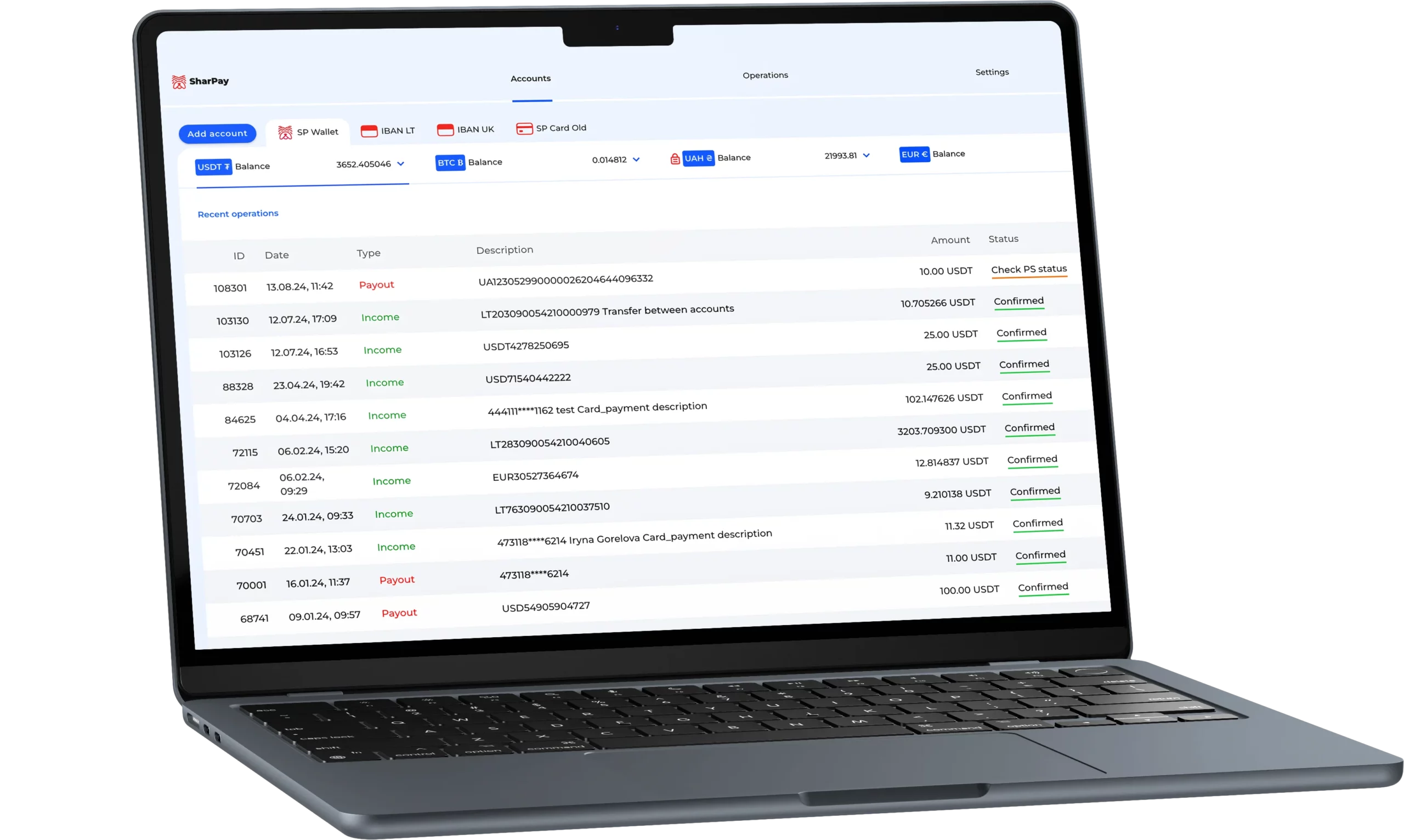
Why businesses choose SharPay for crypto processing
What is included
✅ Crypto acceptance
On your site, in your app or by link.
API, hosted page or plugin.
✅ Business verification
KYC, KYB and AML before launch.
Only verified merchants on the platform.
✅ Shared reporting
Crypto and card payments together.
One view for finance.
✅ Crypto payouts
Part of mass payouts.
Many recipients in one run.
✅ Crypto or euro
BTC, ETH, LTC, XRP, USDC, DAI, TUSD.
Keep crypto or convert to euro.
✅ Onboarding via sales
From 5 days with a complete
document package.
What crypto payment processing covers
Taking a crypto payment is the easy part. Cryptocurrency payment processing is everything around it: who is allowed to accept payments, how each payment is recorded and how money leaves the business again. A gateway alone does the first step, whereas processing takes care of the whole chain.
1. Acceptance
Customers pay in crypto on your website, in your app or through a payment link. The technical side, from the API to plugins, is described on our crypto payment gateway page.
2. Verification
Before the first payment, we check your company with KYC, KYB and AML procedures. Since every merchant on the platform goes through the same review, the environment you work in stays clean.
3. Accounting
Each crypto payment appears in the merchant dashboard next to your card payments. As a result, revenue from all channels can be reconciled in one place.
4. Payouts
When you need to pay affiliates, sellers or contractors, crypto payouts run as part of mass payouts, together with bank transfers and cards.
Crypto processing with KYC, KYB and AML checks
We see the checks as part of the product, not a hurdle in front of it. A processor that onboards anyone sooner or later loses its banking partners, and its merchants lose their payments along with them.
What we check
- The company — registration and incorporation documents
- The owners — beneficial owners and directors under KYC
- The business — what you sell, to whom and how money flows
- Licenses — where your activity requires them
Why it works in your favor
A verified merchant is a stable merchant. Once you have passed the review, there is less risk of payments being held later over questions nobody asked at the start. That said, the review takes time, which is why a complete document package matters so much.
What to prepare
Most delays come from missing papers rather than from the review itself. So collect company documents, ownership details and a short description of your payment flows before you apply. For the practical side, see our article on getting started with crypto payments safely.
Crypto payments for business: who it suits
Crypto works best where customers already hold it or where cards fail too often. These are the cases where it usually pays off.
E-commerce
Online stores add crypto as an extra payment option for customers who prefer it. Card payments stay the main channel, while crypto brings in buyers who would otherwise leave.
SaaS and subscriptions
Software companies with customers worldwide often see card declines on cross-border payments. Crypto gives those customers another way to pay, especially for annual plans.
Digital goods and services
Software licenses, online courses, hosting and other digital products are delivered immediately, so the payment and the delivery need to stay in sync. That is easier when payments and reporting live in one system.
High-risk businesses
Licensed businesses in high-risk verticals go through a deeper review and get individual terms. How that works for crypto is explained in our article on accepting crypto payments on high-risk websites.
Risks of crypto payments and how businesses manage them
Accepting crypto payments for business brings two main risks: the price can move, and the rules keep changing. Neither is a reason to avoid crypto, but both should be planned for before launch rather than after the first bad week. Customer mistakes and refunds need a plan too.
Volatility
A coin can lose several percent between the moment the customer pays and the moment you use the money. For this reason, many businesses accept stablecoins, whose price is pegged to a fiat currency. SharPay also lets you convert incoming crypto to euro inside your account whenever you choose, and whatever you don’t convert stays in crypto.
Compliance
Regulators treat crypto as an area of increased risk. Working with a processor that runs KYC, KYB and AML checks means part of that burden is handled before money reaches you.
Mistakes by customers
A customer can send the wrong amount or use the wrong network. Clear instructions at checkout prevent most of these cases. Even so, your support team should know how such payments are handled under your terms.
Refunds
A blockchain transfer cannot be reversed the way a card payment can. Consequently, refunds need a clear policy: who gets the money back, in what form and within what time.
Blockchain payment processing next to your card business
For most companies, crypto is an addition to cards, not a replacement. So it makes sense to run both through one provider and one set of reports.
Cards and crypto in one dashboard
Card payments go through SharPay payment processing, crypto payments through the crypto gateway, and both appear in the same merchant dashboard. Finance gets one picture instead of two.
Merchant account for card revenue
If you also need card acquiring, tell your manager at the start; a merchant account is where card revenue lands before it reaches your company account.
Money in, money out
Money comes in by card or crypto and goes out by bank transfer, card or to a crypto wallet. Bulk payouts cover the outgoing side; our guide to crypto mass payouts shows how companies pay hundreds of partners at once.
What a crypto payment processor costs
The core crypto fees are published. Crediting incoming crypto and withdrawing it both cost the network fee, and converting to euro carries a currency exchange fee. Merchants with large volumes can discuss terms with their manager.
Crypto fees at a glance
- Crediting — network fee; minimum BTC 0.001, ETH 0.003, LTC 0.001, XRP 1, DAI 10, TUSD 10, USDC 15
- Withdrawal — network fee; minimum BTC 0.001, ETH 0.005, LTC 0.002, XRP 1, DAI 15, TUSD 15, USDC 30
- Conversion to euro — 1.5% currency exchange fee for a business account
Where to see account fees
The full fee table, including the crypto wallet section, is on the price page. Funds you keep in crypto stay in crypto, and you convert to euro only when you need to.
How to start crypto processing with SharPay
Businesses are onboarded only through our sales team. The path is short when the documents are ready, and your manager stays with you after launch as well.
1. Request
Describe your business, expected volume, your customers and whether you also need card processing or payouts.
2. Review
We run KYC, KYB and AML checks. Onboarding takes at least 5 days when the document package is complete; complex verticals take longer.
3. Terms
Your manager walks you through the supported coins and fees and answers questions about your setup. Once the terms are signed off, you move to integration.
4. Launch
Your developers connect through the API, the hosted page or a plugin, and the first payments start coming in.
FAQ
What is crypto payment processing?
It is the full service around crypto payments: accepting them, checking the merchant and the funds, recording each payment and paying money out. A gateway is only the part that connects your checkout.
How is a crypto payment processor different from a checkout integration?
The integration, or gateway, is the technical connection on your site or in your app. The processor covers verification, accounting and payouts as well. SharPay provides both, so you deal with one provider.
Do I need to pass KYC and KYB?
Yes. Every business goes through KYC, KYB and AML checks before the first payment. This is a requirement for all merchants, and it protects your payments later.
Which coins can I accept, and how are funds credited?
You can accept BTC, ETH, LTC, XRP, USDC, DAI and TUSD. Incoming crypto is credited to your SharPay crypto wallet for the network fee, and you can keep it in crypto or convert it to euro inside SharPay.
Can I pay partners in crypto?
Yes. Payouts to crypto addresses are part of mass payouts, so you can pay many recipients in one run.
How long does onboarding take?
At least 5 days with a complete document package. The exact time depends on your documents and your vertical.