


Payment gateway for your website and online business
SharPay is an online payment gateway that takes cards, local payment methods and crypto on your website and settles the money to your merchant account. You connect it through an API, a hosted payment page or a ready-made plugin, and a dedicated manager walks you through onboarding instead of leaving you with a sign-up form.
API and hosted pageCards, local methods, cryptoWooCommerce and OpenCartGo live in 5+ days
Send a request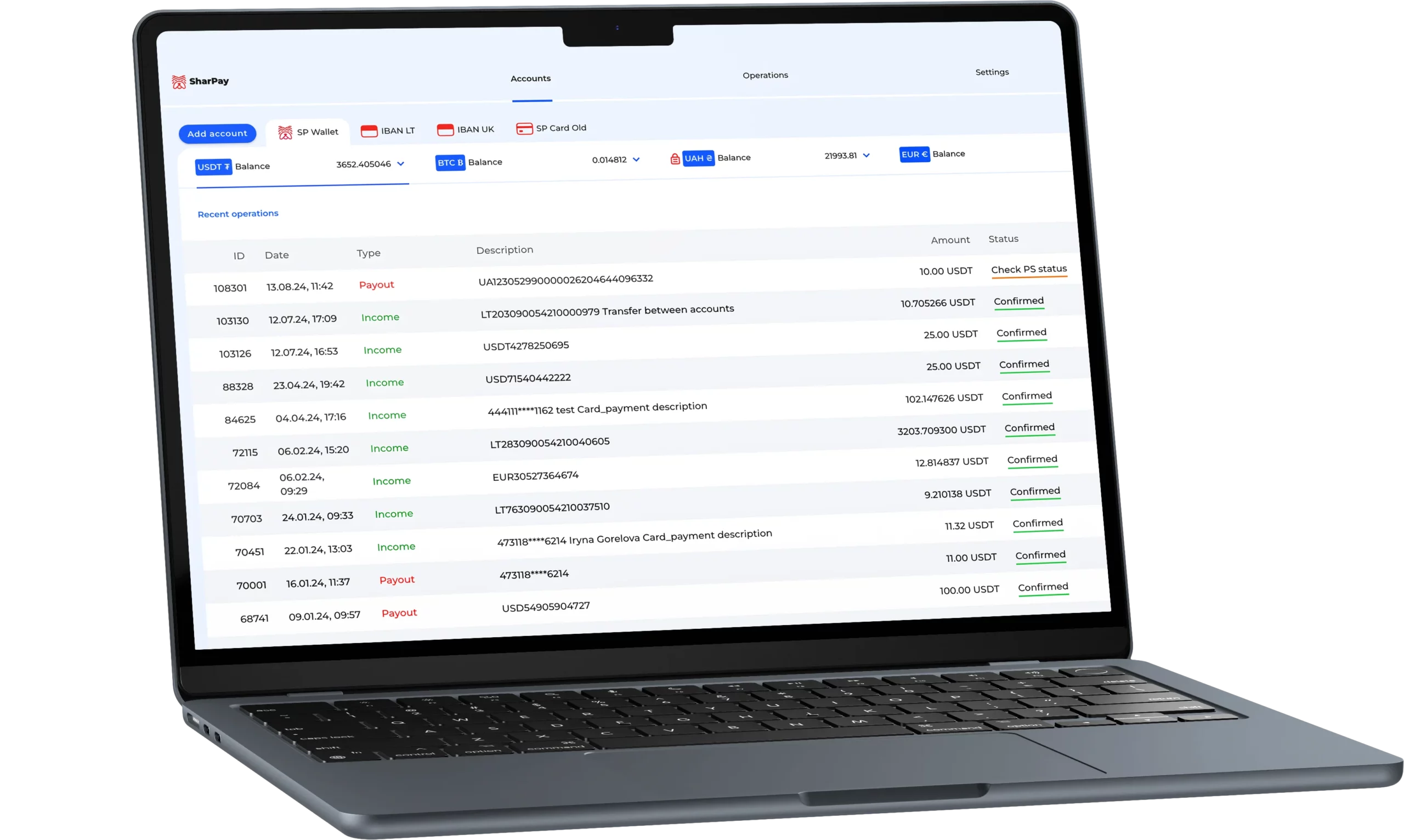
Why businesses choose the SharPay payment gateway
Key features
✅ Payment gateway API
Host-to-host for a checkout on your site.
Documentation from our team.
✅ Hosted payment page
Customers pay on a secure SharPay page.
No card data on your servers.
✅ Plugins
WordPress (WooCommerce) and OpenCart.
Other platforms via the API or payment links.
✅ Payment methods
Cards, local methods and crypto.
Several currencies at checkout.
✅ Cascade and retries
A second provider if the first declines.
Failed charges sent again.
✅ Merchant dashboard
Every transaction in one place.
Payment pages and conversion data.
How the SharPay payment gateway works
A payment gateway is the link between the checkout on your site and the banks behind the customer’s card. It carries the payment data out, brings the answer back and makes sure nothing leaks in transit. Customers see none of this; they press Pay and wait for the result.
1. The customer pays
At your checkout or on the hosted payment page, by card, a local payment method or crypto. Card data travels encrypted from the first click.
2. The payment is checked
3-D Secure and real-time fraud monitoring look at the transaction before it goes further. Suspicious payments stop here instead of turning into chargebacks a month later.
3. The bank answers
The gateway sends the request for authorisation and returns an approval or a decline to your site. If the first provider declines, the payment can go through the second one in the cascade, which saves sales that would otherwise be lost.
4. The money is settled
Approved payments reach your merchant account and are settled on the schedule set in your terms (T+7 for high-risk businesses). Because SharPay is the gateway and the processor at once, you track the whole path in one dashboard.
Payment gateway integration: API, hosted page or plugin
How you connect depends on who builds your site and how much of the checkout you want to control. Most businesses pick one of four routes, and you can switch routes later without changing provider.
Hosted payment page
The quickest way to put a payment gateway on a website. The customer is sent to a secure SharPay page, pays and comes back to your site. Card data never touches your servers, so your security workload stays small.
Payment gateway API (host-to-host)
For teams that want the checkout to stay entirely on their own domain. Your developers work with the API directly, while a mobile SDK covers apps. Our team sends the documentation once the request is approved.
WooCommerce and OpenCart plugins
Ready-made plugins exist for two platforms: WordPress with WooCommerce, and OpenCart. You install the module, add your credentials and start testing payments. For any other CMS, the route is the API or a payment link.
Payment links and invoices
No website, or a sale closed by phone or chat? Send the customer a payment link and the money arrives the same way as a checkout payment. It also works well for B2B invoices.
International payment gateway for cards, local methods and crypto
Customers abroad leave when the checkout shows a currency they do not recognise or a method they never use. An international payment gateway fixes both, which is why conversion is where cross-border shops usually see the difference first.
What your customers can pay with
- Cards — debit and credit cards with 3-D Secure
- Local payment methods — the options shoppers in each market are used to
- Crypto — accepted alongside cards and shown in the same dashboard
- Payment links — for sales outside the website checkout
Currencies and settlement
The gateway supports multiple currencies at checkout, while settlement runs in euro over SEPA and like-for-like payouts go to your IBAN. If you also send and receive transfers, a business account for international payments keeps incoming and outgoing money side by side.
A second route when the first fails
A single acquirer is a single point of failure. With two providers in cascade, a declined payment gets a second attempt with the other provider, while retry logic resends charges that failed for technical reasons. Why that matters is covered in our article on choosing a backup payment provider.
A payment gateway for e-commerce, SaaS, marketplaces and high-risk business
The gateway is the same for everyone. What changes is the checkout, the payment pattern and how closely the underwriter reads your file.
E-commerce and online stores
An ecommerce payment gateway has to be fast at checkout and simple to install. Stores on WooCommerce or OpenCart start with a plugin, while custom stores use the hosted page or the API.
SaaS and subscriptions
Monthly charges need recurring billing and retries for failed cards, since an expired card should not cost you a customer. More on this in our guide to choosing a SaaS payment gateway.
Marketplaces and platforms
Platforms that collect money for many sellers use split payments and escrow on top of the gateway, then pay sellers through business payouts.
High-risk businesses
Licensed businesses in regulated or dispute-prone niches go through a deeper review and get individual terms. How approval works is explained in our article on how a high-risk payment gateway.
Secure payment gateway: PCI DSS, PSD2 and chargebacks
Security is not a badge in the footer. It decides whether a customer trusts your checkout and whether you keep the money you have already earned.
What protects each payment
- PCI DSS — card data is handled to the card industry standard
- PSD2 — strong customer authentication for European payments
- 3-D Secure — the bank confirms the cardholder before the charge
- Real-time monitoring — unusual activity is flagged as it happens
Chargebacks and disputes
We handle chargebacks and disputes on your behalf and tell you about account updates in advance, so an account restriction does not come as a surprise. With the hosted payment page, your own PCI scope stays small because card data never reaches your servers. A full security checklist is in our article on choosing a secure online payment gateway.
Payment gateway fees and pricing
Payment gateway charges depend less on the provider’s price list and more on your business model: refunds, disputes, delivery times and where your customers are. That is why we quote after reviewing your business, not before.
What you pay
- Middle-risk businesses — fees from 1.8%, on transparent terms with no hidden charges
- High-risk businesses — MDR from 3% to 5% depending on your vertical, plus 0.50 EUR per transaction
- High-risk settlement — T+7, in euro over SEPA at 0.20%
- Rolling reserve — 10% held for 180 days, standard for high-risk; for middle-risk businesses it depends on your profile
What moves the price
A store with instant delivery and few refunds is priced differently from a subscription service with delayed delivery. We can also build an individual solution for your business, so the final rate is set after the review. Account fees are on the price page, and a breakdown of typical costs is in our article on ecommerce payment gateway cost.
How to connect the SharPay payment gateway
You do not set up the gateway alone. Onboarding runs through our sales team, and a manager stays with you from the first request to the first live payment.
1. Send a request
Tell us what you sell, your monthly volume, where your customers are and which platform your site runs on.
2. Pass the review
We check the company: registration and constitutional documents, licences where your activity needs them, and the business model.
3. Choose the integration
Hosted page, API, a WooCommerce or OpenCart plugin, or payment links. Terms are agreed individually and depend on your business.
4. Go live
Onboarding takes at least 5 days when the document package is complete; complex verticals take longer. Card processing is covered in more detail on our payment processing page.
FAQ
What is a payment gateway?
It is the service that passes payment data from your checkout to the banks and card networks and returns the result to your site. In practice, it is what lets a website accept a card payment safely. Our article SharPay, your universal payment gateway explains it in more detail.
What is the difference between a payment gateway and a payment processor?
The gateway connects your checkout and carries the payment data, while the processor moves the money and settles it. SharPay does both, so you deal with one provider and one dashboard.
How do I add a payment gateway to my website?
If your site runs on WordPress with WooCommerce or on OpenCart, use the plugin. Any other site uses the hosted payment page or the API, and our team sends the documentation after the review.
Can I accept crypto through the payment gateway?
Yes. Crypto payments are accepted alongside cards and appear in the same merchant dashboard.
How long does it take to connect?
At least 5 days, provided your documents are complete. The timeline depends on the document package and how complex your vertical is.
How much does a payment gateway cost?
Middle-risk businesses pay from 1.8%, while high-risk MDR is 3% to 5% plus 0.50 EUR per transaction. Your exact rate depends on the business model, so the fastest way to get it is to send a request to our team.
Can I launch a payment gateway under my own brand?
Yes. PSPs, fintechs and platforms that want to offer payments to their own merchants can take the same infrastructure as a white-label product: the gateway, card issuing, IBAN accounts and processing under their name. Launch takes 2–4 weeks instead of 12–18 months of in-house development. Details are on the SharPay White Label page.
Do you work with high-risk businesses?
Yes, if the business is licensed and fully legal. Each application is reviewed individually, and terms depend on the vertical and the documents.