

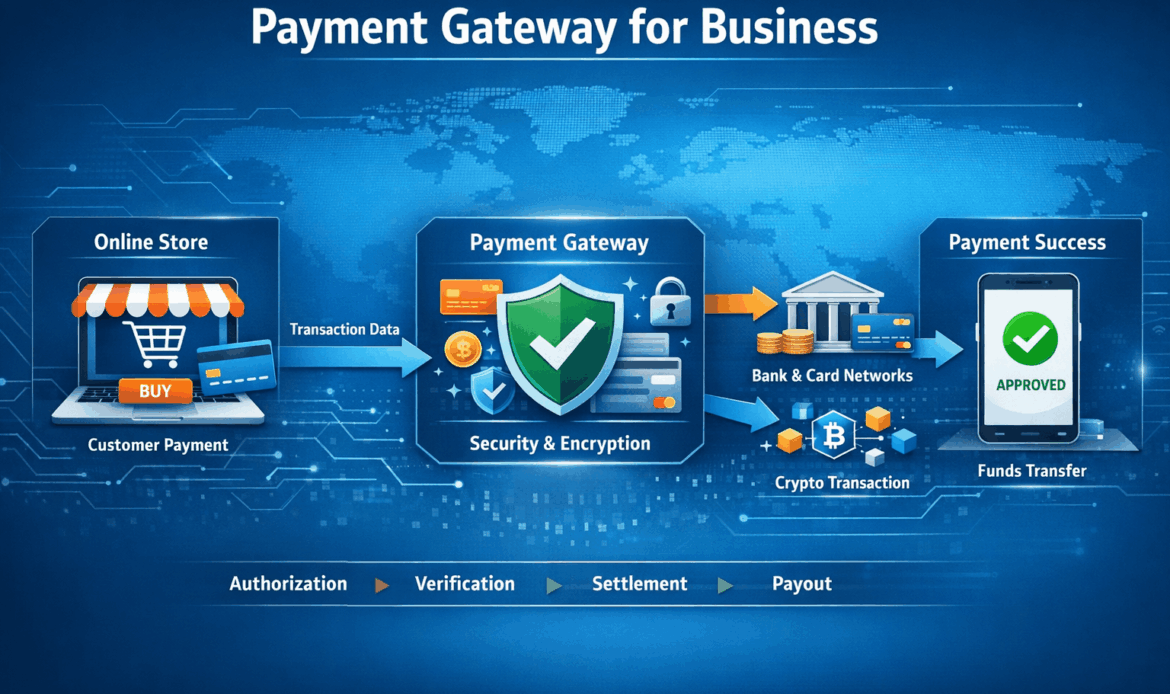
A payment gateway is no longer just a technical tool for accepting payments. In 2026, it is a core element of business infrastructure that directly impacts conversion rates, transaction success, customer experience, and scalability. Companies that use advanced payment gateway solutions don’t just process payments — they optimize revenue streams, reduce failed transactions, and improve customer trust.
For eCommerce, SaaS platforms, marketplaces, fintech products, subscription services, and crypto businesses, a payment gateway is a critical part of the product itself. It sits at the intersection of UX, security, payment processing, fraud prevention, analytics, and global scalability.
In this guide, we explain how payment gateways work, what features matter most, how to choose the right solution, and how to build a payment infrastructure that supports business growth. We’ll also show how it connects with other SharPay solutions like payments, payment processing, merchant accounts, and White Label solutions.
What Is a Payment Gateway
A payment gateway is a technology that securely transfers payment data between a customer, a business, and financial institutions. It acts as a bridge between the checkout page and the payment processing network.
When a customer clicks “Pay,” the gateway encrypts the data, sends it to the processing system, and returns the transaction result in seconds. While the process looks simple, it involves complex infrastructure and multiple verification steps.
It’s important to distinguish between a payment gateway and payment processing. The gateway handles the connection and data transfer, while processing executes the transaction itself.
How a Payment Gateway Works
- The customer selects a product or service and proceeds to checkout.
- The payment form is displayed via API or hosted solution.
- The customer enters payment details or selects a payment method.
- The gateway encrypts and sends data to the payment processor.
- The system verifies funds, risk parameters, and authorization.
- The response is returned: approved, declined, or requires verification.
- The business receives the result and completes the transaction.
This entire flow must be fast, secure, and stable. Any friction at this stage reduces conversion. That’s why businesses should view payment gateways as part of a broader infrastructure including payments and financial systems.
Why Payment Gateways Impact Revenue
A poorly optimized payment gateway leads to lost revenue. Customers abandon payments due to errors, slow loading times, or unsupported methods.
A strong gateway improves:
- Payment conversion rates
- Transaction success rate
- Customer trust
- Global reach
It also reduces operational overhead through automation, analytics, and system integration with tools like merchant accounts, business IBAN, and payouts.
Who Needs a Payment Gateway
Any business that accepts online payments needs a payment gateway. This includes:
- Online stores
- SaaS platforms
- Marketplaces
- Fintech services
- Crypto platforms
For companies operating at scale, it’s essential to integrate multiple financial tools like wallets, cards, and payment infrastructure into a unified system.
Key Features of a Modern Gateway:
Security
Encryption, fraud detection, and data protection are critical.
Speed
Fast processing improves user experience and conversion.
Multiple Payment Methods
Support for cards, transfers, and alternative methods increases success rates.
API Integration
Flexible APIs allow seamless integration into business systems.
Analytics
Detailed insights help optimize performance.
Scalability
The system must support growth and international expansion.
Ecosystem Integration
Gateways should integrate with merchant accounts, IBAN, and payout systems.
Types of Payment Gateways:
Hosted Gateway
Redirects users to a payment page.
Integrated Gateway
Embedded directly into your platform.
Omnichannel Infrastructure
Combines payments, accounts, payouts, and analytics.
White Label Gateway
Launch your own branded payment solution with White Label.
How to Choose a Payment Gateway
Key factors:
- Business model
- Scalability
- Integration capabilities
- User experience
- Pricing transparency
Check pricing before making a decision.
Common Mistakes
- Choosing based only on fees
- Ignoring UX
- Lack of integration
- Poor scalability
FAQ
What is a payment gateway?
A system that enables online payments.
Gateway vs processing?
The gateway transfers data, processing executes transactions.
Where to learn more?
See how it works or FAQ.
Start with SharPay
SharPay provides a complete payment infrastructure: gateway, processing, accounts, IBAN, wallets, and White Label solutions.